
Concrete Blog
How Long Does Stamped Concrete Last? Durability Guide for Indiana Homeowners
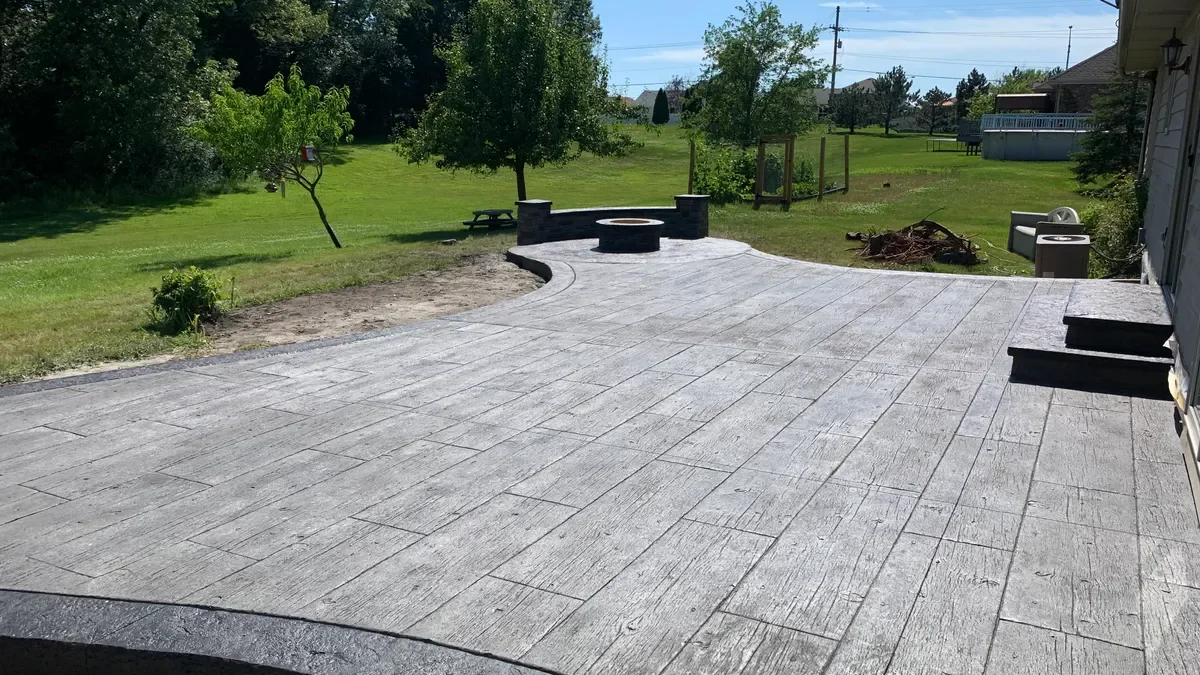
How long does stamped concrete last? With proper installation and routine maintenance, stamped concrete typically lasts 25 to 30 years. Reaching that upper end in Northwest Indiana takes consistent sealing habits, because the region's winters put concrete through a real stress test.
Each freeze-thaw cycle works water into the surface pores, where it freezes, expands roughly 9% in volume, and slowly breaks the sealer down from the inside. Pair that with the road salt tracked in every winter, and NW Indiana stamped concrete faces more wear than concrete in milder climates. Homeowners who stay on their sealing schedule consistently reach the 25- to 30-year mark.
Hoosier Concrete Construction has been installing stamped concrete for homeowners across St. John, Crown Point, and Valparaiso since 1998. In this blog post, we unpack the local factors that determine stamped concrete’s real-world lifespan.
What Shortens the Lifespan of Stamped Concrete in NW Indiana?
Several regional factors cut into that timeline:
Clay Soil and Sub-Base Preparation
NW Indiana's glacial clay soils expand when wet and contract as they dry. That movement transfers directly into any slab on top of them. A compacted granular sub-base breaks that connection. Slabs poured over poorly prepared clay crack early, and the damage typically shows up at the edges first.
Deicer and Road Salt Exposure
Rock salt and chloride-based deicers accelerate spalling, the flaking and pitting that damages the top layer of concrete. Roads throughout Lake and Porter counties are heavily salted through winter, and that chloride migrates onto patios, walkways, and driveways via boot soles and snowmelt. The damage compounds year after year, which is why NW Indiana stamped concrete shows salt-related wear faster than slabs in unsalted climates.
Skipped or Delayed Sealing
Sealer keeps water out. Water that gets into unsealed concrete freezes, expands, and forces the surface apart from the inside. In drier climates, resealing every three to four years is often adequate. In NW Indiana, every two to three years is the practical standard.
When and How to Reseal Stamped Concrete in Indiana
Fall is the right time for resealing: after summer heat has passed but before hard freezes arrive, so the sealer cures fully before the first freeze. The field test takes 30 seconds. Pour water on the surface. If it soaks in rather than beading, it's time. Decorative concrete benefits from a light surface cleaning before resealing since salt residue shortens how long the new coat holds.
Air-entrainment (a mix formulated with tiny air pockets that relieve freeze-thaw pressure) is equally important from the start. It's a key reason a well-built slab in St. John outlasts one poured without it.
Signs Your Stamped Concrete Needs Attention
Surface fading and minor wear are normal. These signs call for a professional look:
-
Cracks wider than a hairline running across the slab rather than following control joints
-
Spalling that exposes the aggregate beneath the finished layer
-
Sections that have shifted relative to adjacent concrete
-
Standing water pooling after rain, pointing to drainage or settlement issues
Cracks and spalling worsen through freeze-thaw seasons without intervention. Hoosier Concrete Construction helps homeowners across Crown Point, Valparaiso, and the surrounding Lake and Porter counties assess existing slabs and determine the right next step.
Frequently Asked Questions
Does stamped concrete hold up in Indiana winters?
Yes. Stamped concrete installed with an air-entrained mix and sealed on schedule handles Indiana winters well. Air-entrainment builds microscopic relief pockets that absorb freeze-thaw pressure—the primary stress mechanism in NW Indiana. Skipping the sealer is where most winter damage starts.
Can stamped concrete be repaired if it cracks?
Minor surface cracks can often be filled and recolored, though it can be challenging to match an aged slab exactly. Structural cracks from sub-base movement are harder to repair cosmetically and may call for a replacement instead. Hoosier Concrete Construction assesses existing slabs and gives homeowners a straight answer.
Is stamped concrete more high-maintenance than regular concrete?
Stamped concrete needs resealing every two to three years in NW Indiana. Plain broom-finish concrete doesn't require sealing to stay structurally sound, but it has no color or texture to protect it. The commitment is modest: the key is staying on schedule rather than letting seasons slip between applications.
Plan for the Long Haul with Hoosier Concrete
Sub-base prep, the right mix design, and consistent sealing are what separate a surface that still looks sharp after decades from one that starts spalling early. Building the job right from the start is the answer.
If you’re planning a stamped patio, walkway, or driveway replacement in St. John, Crown Point, or Valparaiso, contact Hoosier Concrete for a free quote or call (219) 712-3508.