
Concrete Blog
Concrete Patio vs Paver Patio: Which Is the Better Investment Long-Term?
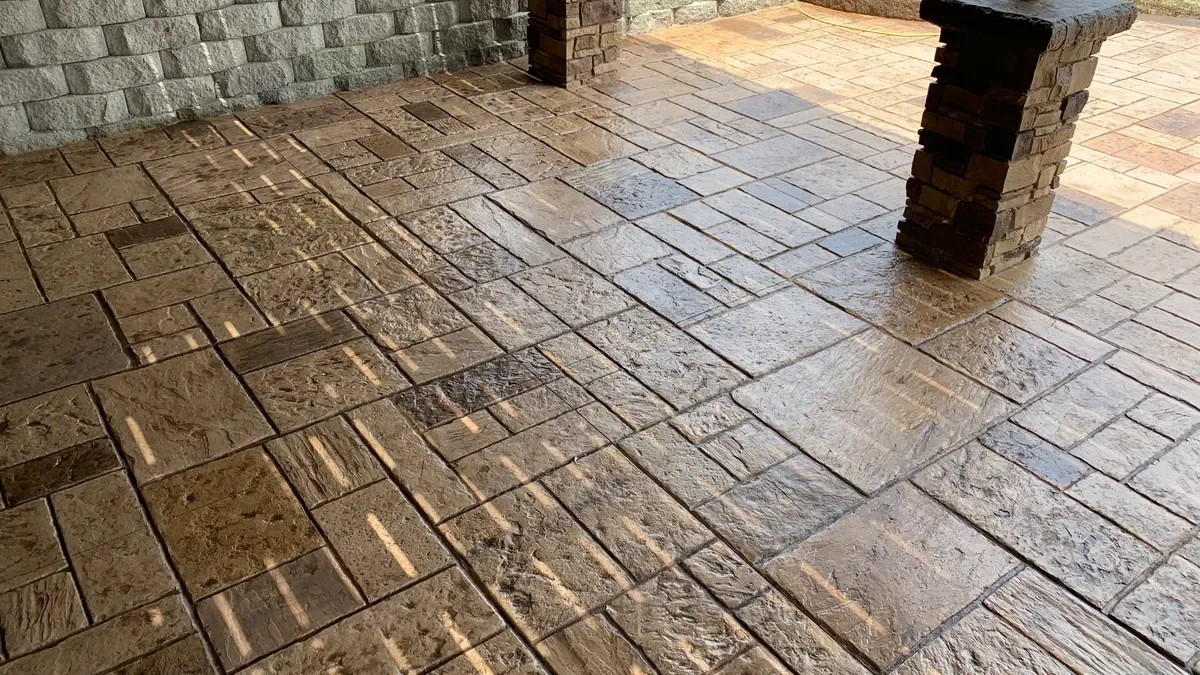
A standard concrete patio in Northwest Indiana costs $6 to $25 per square foot installed, while pavers usually run $15 to $30 or more. While that upfront price difference looks significant, the long-term maintenance costs over the next ten years make the total investment between the two options much closer than most homeowners expect.
In our 28 years of pouring decorative slabs and tearing out failed paver patios around St. John and Crown Point, we keep seeing the same thing: paver problems start at the joints, not the stones. Sand washes out, weeds take root, and individual pavers begin to loosen and wobble by year eight or ten. By contrast, a poured decorative concrete patio stays flat for decades when resealed every two to three years.
Upfront and Installed Cost Compared
The overall cost of a concrete patio vs. a paver patio comes down to labor, not material. A broom-finish slab pours in one day on a 400-square-foot patio. A paver install takes three to four days of hand-laying, edge restraint, and polymeric sand sweep.
Per-Square-Foot Pricing in Northwest Indiana
-
Broom-finish concrete: $6 to $10 per square foot installed
-
Colored or scored concrete: $8 to $14 per square foot
-
Stamped or decorative concrete: $14 to $22 per square foot
-
Standard pavers: $15 to $22 per square foot installed
-
Premium pavers: $22 to $30 or more per square foot
Durability Through Indiana Freeze-Thaw
Northwest Indiana patios face 35 to 50 freeze-thaw cycles each winter season, plus heavy lake-effect humidity. The two surfaces respond differently. Concrete poured at 5 to 6 inches with proper control joints and air-entrained mix handles the cycle predictably. Pavers shift, lift, and settle as the sub-base moves underneath, which is why stamped concrete installation in Indiana depends so heavily on base prep and joint planning.
Pavers have one structural advantage: individual stones move with frost heave instead of cracking. A failed paver can be lifted out and reset, which is something you can’t do with a cracked concrete slab. That flexibility is the strongest argument for pavers in the Indiana climate, especially across Lake and Porter County where soil and moisture change by neighborhood.
Maintenance, Repair, and the 10-Year Math
Year one feels about the same either way. By year five, the difference shows up in maintenance. By year ten, it's hard to miss.
Annual Upkeep on a 400-Square-Foot Patio
A concrete patio needs resealing every two to three years (roughly $1.50 per square foot) plus a winter salt rinse. That's the whole routine.
A paver patio asks for more, and more often: annual joint-sand top-ups, weed pulling between stones, the occasional power-wash, and a full polymeric sand re-application every three to four years.
What Year Ten Actually Looks Like
A 10-year-old stamped concrete patio in St. John usually needs nothing more than a fresh reseal and still looks close to new.
A 10-year-old paver patio of the same size typically needs 30 to 60 stones lifted and reset, the edge restraint replaced, and the polymeric sand fully renewed. That's the year the upfront savings start to even out.
Style Flexibility and Resale Value
Pavers come in modular sizes and shapes, which makes them easier to design around curves and small spaces. Stamped concrete catches up on visual variety with pattern mats and multi-tone color hardeners. Resale value tilts slightly toward pavers in higher-end neighborhoods but tilts toward decorative concrete in mid-market suburbs.
Frequently Asked Questions
Is a concrete patio cheaper than a paver patio?
A concrete patio is cheaper than a paver patio by $4 to $15 per square foot in Northwest Indiana. On a 400-square-foot patio, that gap works out to $1,600 to $6,000 in upfront savings. Decorative finishes narrow the gap but rarely close it, and the labor differential drives most of the swing rather than material cost.
Do pavers last longer than concrete in Indiana?
Pavers can last 25 to 50 years as stones but typically need joint and base maintenance every 8 to 12 years in Indiana freeze-thaw conditions. A well-poured decorative concrete patio can last 25 to 30 years with sealing every two to three years and no joint maintenance. Total lifespan is comparable; ongoing labor is not.
Does a concrete or paver patio add more value at resale?
A paver patio adds slightly more resale value in upscale Lake County neighborhoods, while a decorative concrete patio adds comparable value in mid-market suburbs and reads as more move-in-ready to buyers. The patio finish, size, and integration with the yard usually drive resale impact more than material choice alone.
Pick Your Patio Investment With Eyes Open
If upfront cost and low ongoing maintenance carry the most weight, decorative concrete wins. If frost-heave flexibility and modular repair matter more, pavers win. Both deliver 25-plus years when installed and maintained well in Indiana climate.
For a free quote on a concrete patio in Lake or Porter County, contact Hoosier Concrete Construction at (219) 712-3508.